
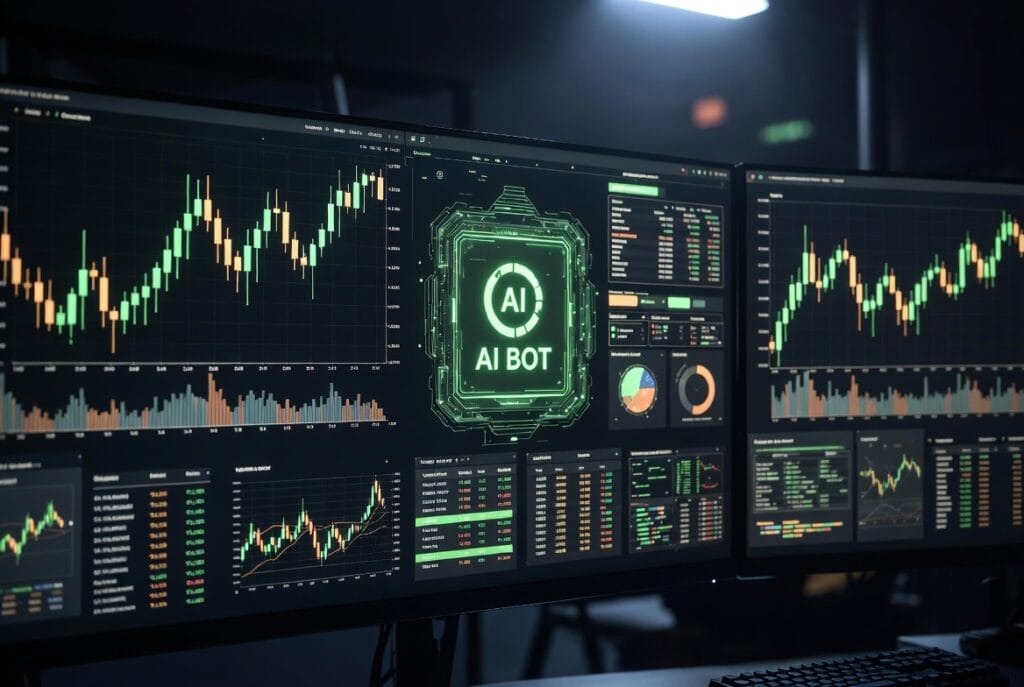
For decades, algorithmic trading was the exclusive territory of hedge funds with nine-figure technology budgets and PhDs writing proprietary code. That world is changing faster than most retail investors realize.
AI-powered trading tools are now accessible to individual investors — and some are generating returns that institutional traders are watching closely.
What Changed in the Last Three Years
Three things converged to shift the landscape:
1. Large language models got good at reading financial data. Models like GPT-4 and its successors can now process earnings calls, SEC filings, macroeconomic reports, and news sentiment at a speed no human analyst can match. Platforms have been built on top of these capabilities specifically for trading signal generation.
2. API access to brokerage accounts became standard. Alpaca, Interactive Brokers, and TD Ameritrade opened programmatic trading access to retail users. Combined with AI signal generation, this created a full loop — from analysis to execution — that individuals can now run on a laptop.
3. The cost of compute dropped dramatically. Running a sophisticated trading algorithm in 2020 required serious infrastructure. In 2026, it runs on a $20/month cloud instance.
Where AI Bots Are Actually Winning
AI trading systems do not beat humans at everything. They beat humans at specific, well-defined tasks:
Speed and consistency. A bot executes the same strategy identically at 2am on a Tuesday as it does at market open on an earnings day. Human traders get tired, emotional, and distracted. Bots do not.
Processing volume. An AI system can monitor thousands of tickers simultaneously, flag patterns across multiple timeframes, and execute within milliseconds. A human trader manages a fraction of that.
News sentiment arbitrage. This is where AI has created the most visible edge. Systems trained to read news sentiment and cross-reference it with options flow have generated consistent alpha in short-duration trades — the kind of trades that close before most retail investors even read the headline.
The Tools Retail Investors Are Using
Several platforms have made institutional-grade AI trading tools accessible:
- Composer — build algorithmic strategies with no-code logic and backtest against historical data
- Danelfin — AI stock scoring based on 900+ technical and fundamental indicators
- Tickeron — pattern recognition and AI-generated trade ideas
- Trade Ideas — real-time AI scanning and Holly AI, one of the more established retail-facing trading bots
None of these are get-rich-quick tools. The investors seeing results treat them as systematic frameworks, not magic buttons.
What Hedge Funds Are Saying Quietly
Several mid-sized quantitative hedge funds have publicly acknowledged underperforming simple AI-driven momentum strategies over 12-month periods. That is not a coincidence.
The dirty secret of active management is that consistent alpha generation is extraordinarily hard. AI systems running simple, disciplined strategies without emotional override often outperform active managers running complex, expensive operations.
Renaissance Technologies and Two Sigma are not threatened — their systems are orders of magnitude more sophisticated. But the $500M–$2B quant fund running a team of 30 analysts? That business model is under real pressure.
The Limits Retail Investors Need to Understand
AI trading bots are not a guaranteed edge. Several important limitations apply:
Overfitting risk. A strategy that backtests beautifully on historical data often falls apart in live markets. Past patterns do not always repeat.
Market impact. When too many systems run the same strategy, the edge disappears. Alpha that exists for one trader evaporates when thousands run identical logic.
Black swan blindness. AI systems trained on historical data are not prepared for truly novel events. March 2020 and other crisis periods exposed this weakness clearly.
AI trading tools have genuinely leveled part of the playing field between retail and institutional investors. The gap has narrowed, not closed. Used with realistic expectations and proper risk management, they are worth understanding.
Ignoring them entirely means leaving a real tool on the table. Betting everything on them means misunderstanding what they can and cannot do.
This article is for informational purposes only and does not constitute financial advice.

AI-powered investing insights for the modern retail investor. No hype, no noise — just analysis.
Policy
© 2026 Invessence. All rights reserved.